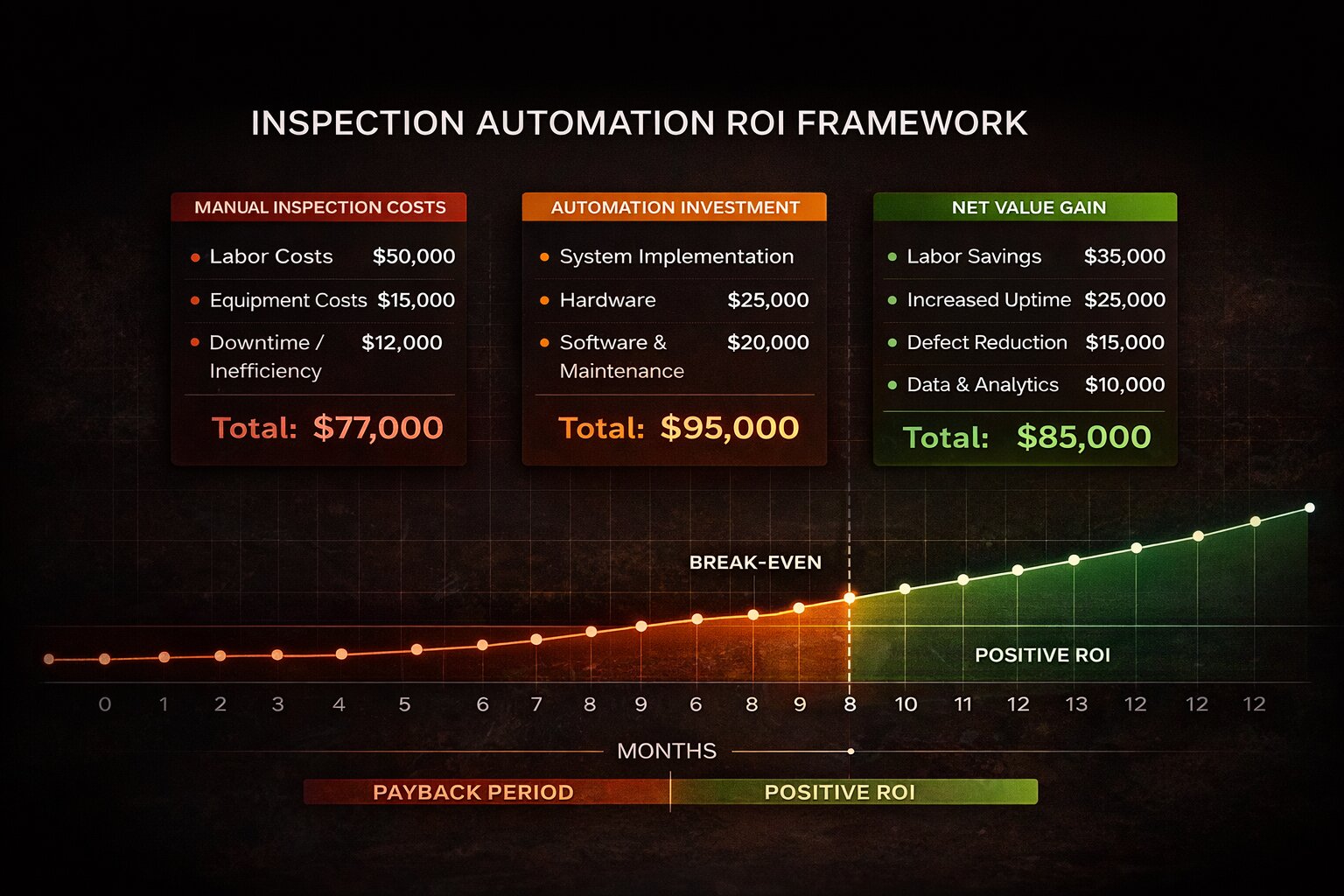
Inspection automation sits in the messy intersection of operations, safety, and technology.
That means the value is rarely a single line item. It is usually a combination of avoided exposure to hazards, fewer unplanned failures, better coverage and consistency, and less time spent finding, triaging, and reporting issues.
So instead of chasing a single "magic ROI," use a framework that forces clarity and makes assumptions transparent.
Why ROI Is Hard for Inspection Automation
ROI debates stall when everyone argues about one number too early.
The value of inspection automation is usually spread across:
- Avoided exposure to hazards
- Fewer unplanned failures (or faster response when issues emerge)
- Better coverage and consistency
- Less time spent finding, triaging, and reporting issues
Use ranges, not point estimates. Use a 5-bucket model. And design your pilot to collect the missing inputs — not to look impressive.
The 5-Bucket ROI Model
Use this as your first-pass model. You will refine it with your site data.
Bucket 1: Safety Risk Reduction
Even if you never put a dollar value on safety, you can still model risk reduction as expected loss avoided: likelihood × consequence.
Practical examples of what changes:
- Fewer people entering confined spaces or working at heights
- Fewer manual interactions around heavy equipment
- Earlier detection of conditions that could lead to incidents
Bucket 2: Uptime and Downtime Avoidance
Inspection affects uptime when it:
- Finds issues earlier (more planning time)
- Reduces detection-to-action cycle time
- Prevents repeat visits or rework
- Enables shorter outages by improving pre-work planning
Start with what you can measure: unplanned downtime hours for a target asset class, and time from "issue exists" to "issue found" to "work issued" to "work complete."
Bucket 3: Labour Efficiency and Inspection Coverage
This is not about replacing inspectors. It is usually about reducing travel and time-to-access, increasing coverage per shift, standardising evidence capture, and reducing time spent writing reports and chasing photos.
Bucket 4: Quality, Rework, and Defect Prevention
This bucket is about avoiding re-inspection because evidence was missing or inconsistent, rework because defects were found late, and secondary damage because early signals were missed.
Bucket 5: Compliance and Reporting Efficiency
In regulated or high-assurance environments, the ability to produce traceable evidence, consistent reporting, and easier audits can be a real cost driver — especially when it reduces scramble time during audits.
ROI Worksheet
Fill this with your baseline numbers. Use ranges if you are not confident yet.
| Bucket | Input(s) you need | Simple calculation idea | Where you usually get the data |
|---|---|---|---|
| Safety risk | Incident exposure frequency; near-miss frequency; consequence categories | Expected loss proxy using likelihood × consequence (use ranges) | Safety reports; job hazard analysis; incident registers |
| Uptime | Downtime hours; cost per downtime hour; MTTR/response time | Avoided downtime hours × internal downtime cost (or use "hours saved" as proxy) | CMMS; production reporting; reliability KPIs |
| Labour | Hours per inspection route; travel/access time; reporting time | Hours saved × loaded labour rate (or redeployed hours) | Time studies; shift logs; work orders |
| Quality/rework | Rework frequency; repeat inspections | Reduced rework hours × cost | CMMS; QA logs; shutdown retros |
| Compliance/reporting | Audit prep hours; evidence retrieval time | Hours saved × loaded labour rate | Audit logs; engineering time sheets |
Add a "confidence" column (Low/Med/High) so procurement can see what is solid and what needs pilot data.
Example: Conservative, Base, and Upside Cases
This is not a claim about typical ROI. It is a demonstration of the worksheet mechanics.
Assume a pilot targets one repeatable inspection route:
- Labour: 8 hours/week saved (travel and reporting)
- Downtime: 2 hours/month avoided through earlier detection and faster routing
- Loaded labour rate: use your internal number
- Downtime cost: use your internal number (or treat as "hours saved" if you prefer)
Compute three cases:
- Conservative: only count labour savings
- Base: labour plus part of downtime avoided
- Upside: labour plus downtime avoided plus reduced rework
This is how you keep the business case defensible while still capturing the real value levers.
Common Mistakes That Cause ROI Disappointment
- Counting hypothetical value but ignoring adoption — Include training, workflow changes, and alert ownership in scope
- Assuming automation equals headcount reduction — Model as redeployed hours, increased coverage, and reduced exposure
- No baseline — Capture 2–4 weeks of current-state time/downtime/rework data before the pilot starts
- No pathway from detection to action — Define triage, verification, and work-order steps and owners before you deploy
- Overprecision too early — Use ranges and confidence; tighten numbers only after pilot data exists
Pilot Measurement Plan: How to Prove ROI in Six Weeks
The pilot's job is to convert low-confidence assumptions into measured inputs.
Minimum measurements:
- Coverage: what percentage of targets were actually captured consistently?
- Cycle time: detection to alert to verification to work order
- Effort: hours spent on inspection and reporting before vs during pilot
- Signal quality: percentage of alerts that are actionable vs noise (and why)
- Operational ownership: do findings reliably land with an owner who acts?
Deliverables you should demand:
- A repeatable runbook ("how we run this inspection every week")
- A simple dashboard for the owners (not just executives)
- An ROI worksheet populated with pilot data and updated confidence levels
How NXTGEN Typically Fits
NXTGEN Inspect supports turning inspection data into decisions — dashboards, alerts, and governance across edge and cloud.
NXTGEN Autonomy supports repeatable task execution and orchestration, so inspection becomes routine, not a demo.
If you want to justify inspection automation without hand-waving, start with one workflow and build the ROI around measured inputs.